
WHY URUGUAY
STANDS APART
GEOGRAPHY, RESOURCES & STABILITY
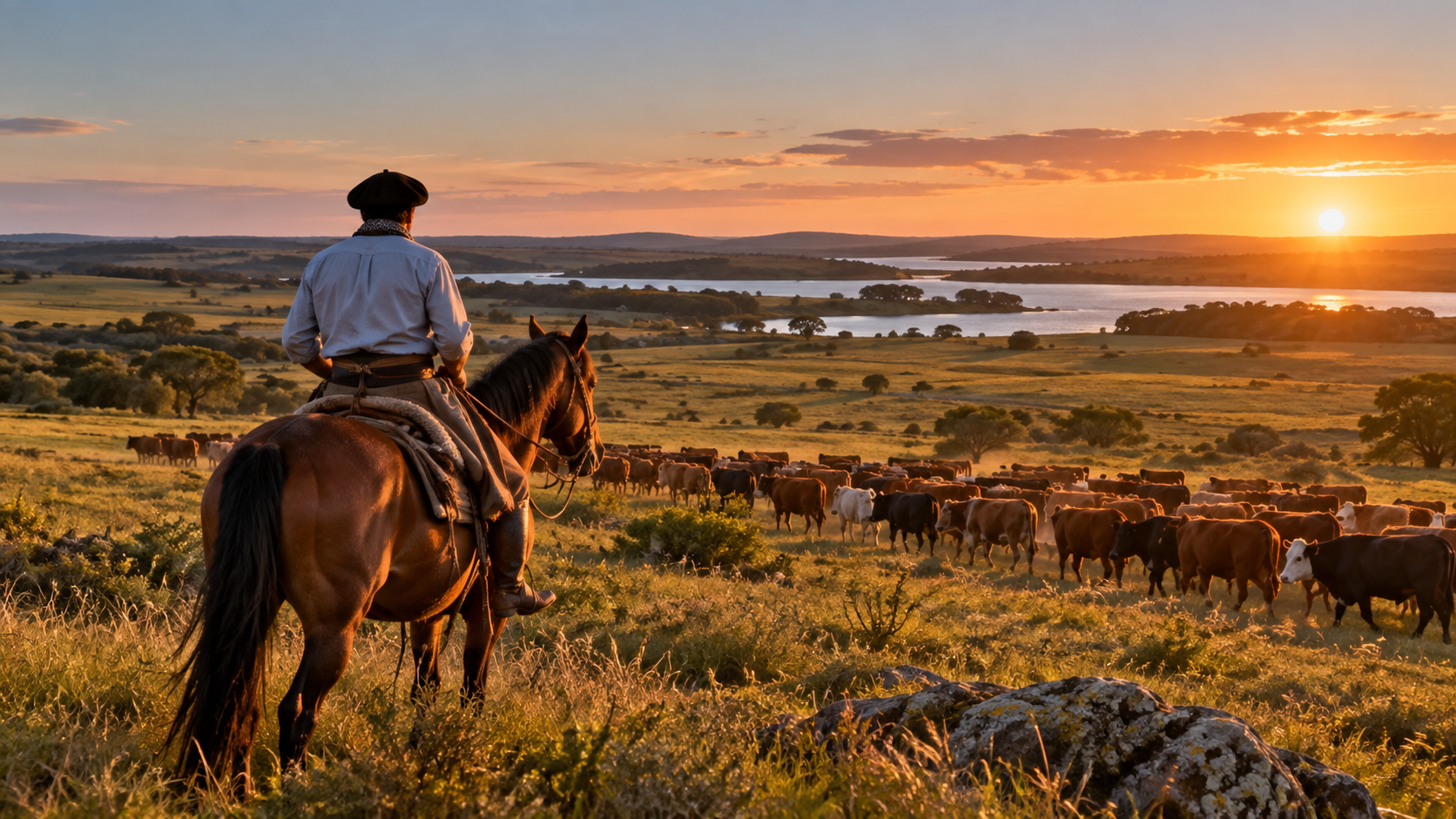
Far from major geopolitical flashpoints — Deep in the Southern Hemisphere and geographically removed from many of the world's principal military powers and conflict zones.
Food security — A small population surrounded by an extraordinary amount of productive agricultural land, with significant domestic production of meat, dairy, grains and other foods.
Abundant freshwater — Uruguay benefits from substantial surface and groundwater resources.
Renewable energy — Almost all of Uruguay's electricity is generated from renewable sources in a typical year, reducing dependence on imported fossil fuels for power generation.
Financial stability — A well-capitalized banking system, investment-grade sovereign credit ratings and comparatively low sovereign risk within Latin America.
The US dollar is part of everyday financial life — Dollar bank accounts are commonplace, and real estate and many other major assets are routinely priced and transacted in US dollars.
A temperate Southern Hemisphere climate — Research into extreme global disruptions has identified Southern Hemisphere geography and continued food-production capacity as potential resilience advantages.
Space — With a population of only a few million people, Uruguay remains remarkably uncrowded outside its principal urban areas.
And somewhere you would actually want to live — Ocean, countryside, good food, international and bilingual schools, modern infrastructure and a relaxed quality of life.
For most people, having a Plan B doesn't mean expecting the worst. It simply means having options — another place in the world where you could own a home, spend part of the year, or eventually build a life if circumstances changed.
Uruguay has an unusual combination of qualities that makes it particularly interesting from that perspective. Its location deep in the Southern Hemisphere places it far from many of the world's major geopolitical flashpoints, while its small population is surrounded by an extraordinary amount of productive agricultural land. It has abundant freshwater resources, a largely renewable electricity system and a financial culture in which the US dollar is already an established part of everyday life.
Researchers studying resilience to extreme global disruptions have also highlighted the potential advantages of Southern Hemisphere geography and the ability of countries to continue producing food domestically. Uruguay would certainly not be immune to a major global crisis, but it possesses several of the characteristics associated with greater resilience.
But for me, the most important part of the Plan B conversation is much simpler: Uruguay is somewhere you would actually want to live.